 FR
FR
 EN
EN
 ES
ES
 PT
PT
Libreville hosts a strategic regional workshop to strengthen FOMAC
Libreville, 12 February 2026 – From 12 to 15 February 2026, the Gabonese capital hosts a high-level regional workshop on strengthening the institutional and operational capacities of the Multinational Force of Central Africa (FOMAC), an essential component of the ECCAS Peace and Security Architecture. Organized at the former headquarters of ..
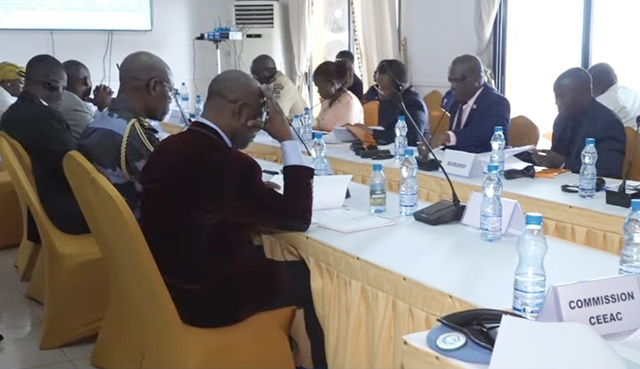
Libreville, 12 February 2026 – From 12 to 15 February 2026, the Gabonese capital hosts a high-level regional workshop on strengthening the institutional and operational capacities of the Multinational Force of Central Africa (FOMAC), an essential component of the ECCAS Peace and Security Architecture.
Organized at the former headquarters of ECCAS in the Upper Gué-Gué district, this meeting brings together representatives of the Member States, general and superior officers, as well as civilian and military experts, around the dynamics of consolidating the Central African Peace and Security Architecture, in accordance with the strategic guidelines defined by ECCAS decision-making bodies and Community legal instruments, including the revised Community Treaty and the Protocol on the Central African Peace and Security Council (COPAX).
Gabon, host country, reaffirms its support for FOMAC
Welcoming the participants on behalf of the host country, Freddy NZE EKEKANG, Commissioner for Regional Integration, representing the Minister for Foreign Affairs and Cooperation, responsible for Integration and Diaspora of the Gabonese Republic welcomed the strong mobilization of delegations and recalled the strategic importance of the topics on the agenda. He highlighted the establishment and management of the Regional Logistics Depot, the clarification of the functions of the Operations Centre and the Regional Movement Coordination Centre, as well as the repositioning of the Regional Major State and the development of a training plan for FOMAC.
In his view, this work will directly contribute to improving the Force's projection capacity, responsiveness and interoperability, which are essential elements for carrying out its tasks of preventing, managing and stabilizing crises in the Community area.
A collective commitment to regional security challenges
In his official opening speech, Mr Hermenegilde NIYONZIMA, Chief Executive Officer, representing the Chairman of the ECCAS Commission, recalled that Central Africa continues to face complex security challenges, including political instability, terrorist threats, cross-border crime and persistent humanitarian crises. Given this context, the capacity-building of FOMAC is a strategic necessity for the stability and prosperity of the subregion.
Mr Niyonzima stressed that this workshop is part of the momentum for the effective implementation of ECCAS legal and strategic instruments, including the revised Treaty and the Protocol on the Central African Peace and Security Council (COPAX), reflecting the political will of the Member States to have a robust, agile and operational regional force.
Work focused on practical operational reforms
During four days, participants will review several major pre-projects, including:
- the establishment and organization of the FOMAC Regional Logistics Depot;
- clarification of the functions of the Operations Centre and the Regional Movement Coordination Centre;
- the repositioning of the regional Major State;
- Development of a training plan for FOMAC.
These themes are of major operational importance and aim to strengthen the chain of command, operational planning, inter-state coordination, as well as the projection capacity and interoperability of forces.
Towards a safer and resilient Central Africa
The discussions, conducted in plenary and in working groups, should lead to concrete and pragmatic recommendations aimed at achieving lasting improvements in the functioning and effectiveness of the FOMAC. At the end of the workshop, the adoption of the final report will mark a decisive step in the consolidation of the Multinational Force and, more broadly, in strengthening the Regional Peace and Security Architecture.
Through this initiative, the ECCAS Commission reaffirms its continued commitment to a more united, resilient and secure Central Africa for the peace, stability and sustainable development of all the peoples of the subregion.